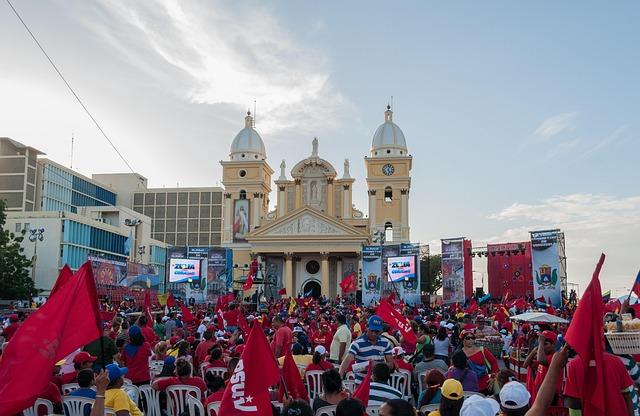
In a groundbreaking progress with far-reaching geopolitical implications, the recent U.S. arrest of Venezuelan President Nicolás Maduro has sent shockwaves through Latin America and the international community. As Caracas grapples with the sudden power vacuum, questions loom large over the future direction of Venezuela’s fragile political landscape and its beleaguered economy. Experts from the University of Chicago weigh in on potential scenarios unfolding in the wake of Maduro’s detention, exploring what this pivotal moment means for U.S.-Venezuelan relations and the broader struggle for stability in the region.
Venezuela’s Political Landscape Faces Uncertain Future After Maduro’s Arrest
The recent arrest of Nicolás Maduro by U.S. authorities has cast a profound uncertainty over Venezuela’s already volatile political environment. Analysts at the University of Chicago emphasize that this unprecedented event could trigger a power vacuum, prompting a scramble among opposition factions and international actors vying for influence. Key issues at stake include the legitimacy of Maduro’s regime, the continuity of governance, and the potential for civil unrest.The coming weeks are likely to reveal whether cracks within the ruling party will deepen or if a cohesive opposition coalition can emerge to steer the country toward democratic reform.
Critical factors to monitor in the post-arrest landscape include:
- Response of the Venezuelan military and security forces
- International diplomatic reactions, particularly from Latin American neighbors
- Economic repercussions impacting a population already grappling with hyperinflation
- Potential shifts in oil production and export policies
| Scenario | Potential Outcome | Timeframe |
|---|---|---|
| Opposition coalition strengthens | New interim government & elections | 6-12 months |
| Military crackdown | Increased unrest & international sanctions | Immediate |
| Fragmented power struggle | Prolonged instability & humanitarian crisis | 12+ months |
Economic Implications and the Struggle for Stability in Post-Maduro Venezuela
The arrest of Nicolás Maduro by U.S. authorities has plunged Venezuela into a new phase of economic uncertainty and political struggle. At the heart of this upheaval lies a fractured economy battered by years of mismanagement,hyperinflation,and sanctions. As new leadership searches for stability, key economic sectors such as oil production, agriculture, and foreign investment face critical challenges.Experts emphasize that restoring confidence among international investors and securing humanitarian aid will be essential tasks for any transitional government.
Meanwhile, Venezuelans remain caught between hope and hardship. The road to recovery will likely include:
- Debt renegotiations with international creditors to ease financial pressures
- Economic reforms focused on diversifying away from oil dependency
- Anti-corruption measures to rebuild institutions weakened under the Maduro regime
- Social programs aimed at addressing widespread poverty
| Economic Indicator | Current Status | Projected Short-Term Change |
|---|---|---|
| Inflation Rate | ~4,000% | Expected to decrease gradually |
| Oil Production (barrels/day) | ~700,000 | Potential for 30% increase |
| Foreign Direct Investment | Near zero | Increasing with political stability |
International Reactions and the Role of Regional Powers in Shaping Venezuela’s Path
The geopolitical landscape surrounding Venezuela has been dramatically recalibrated following the U.S. arrest of President Nicolás Maduro.Key international actors have swiftly voiced their positions, revealing a fragmented response that underscores the complexities of regional influence. While the United States and several Western allies have rallied in support of the move, seeing it as a necessary step toward restoring democracy, countries such as Russia, China, and Cuba have condemned the arrest as an infringement on Venezuela’s sovereignty. This divergence amplifies the ongoing battle for ideological and strategic dominance in Latin America, with each power leveraging diplomatic channels, economic sanctions, and public statements to sway global opinion and ground realities.
Regional powers now stand at a critical juncture, their choices potentially defining Venezuela’s trajectory for years to come. The Caribbean and South American neighbors are balancing concerns over economic stability, migration pressures, and political alliances.Key actors include:
- Brazil: Advocating for a democratic transition while wary of refugee flows.
- Colombia: Prioritizing border security and humanitarian aid.
- Mexico: Calling for dialog over unilateral measures.
- Argentina: Supporting international mediation efforts.
| Country | Stance on Maduro’s Arrest | Primary Concern |
|---|---|---|
| Brazil | Conditional support for transition | Refugee management |
| Colombia | Supportive of U.S. actions | Border security |
| Mexico | Calls for peaceful dialogue | Regional stability |
| Argentina | Promotes mediation | Democratic process |
The interplay between international condemnation and regional pragmatism will shape diplomatic strategies, economic policies, and grassroots mobilization inside Venezuela. Observers anticipate that the coordinated response of these regional powers could either facilitate a negotiated settlement or deepen Venezuela’s protracted crisis, marking the next pivotal chapter in the nation’s ongoing struggle.
Strategic Recommendations for U.S. Policy and Multilateral Engagement in Venezuelan Recovery
U.S. policy must pivot swiftly towards a coordinated and pragmatic approach. Prioritizing support for Venezuela’s democratic institutions while fostering economic stabilization should be the cornerstone of any engagement. This entails leveraging sanctions tools judiciously to punish illicit activities without suffocating humanitarian aid or economic recovery efforts. Encouraging transparent governance through targeted assistance and collaboration with opposition factions can definitely help rebuild the public trust necessary for long-lasting reform.
Multilateral engagement is indispensable to effectively address Venezuela’s complex crisis. The United States should spearhead efforts alongside regional bodies like the Association of American States (OAS), the Lima Group, and the UN to craft a unified strategy. This includes:
- Coordinated humanitarian aid delivery mechanisms.
- Joint frameworks for economic reconstruction and debt relief.
- International monitoring to ensure free and fair future elections.
- Support for anti-corruption measures targeting entrenched networks.
| Focus Area | Key Initiative | Expected Outcome |
|---|---|---|
| Governance | Strengthen electoral frameworks | Enhanced democratic legitimacy |
| Economy | Rebuild infrastructure with international aid | Enduring economic growth |
| Humanitarian | Secure corridors for aid distribution | Reduced humanitarian crisis |
Future Outlook
As the international community watches closely, the arrest of Nicolás Maduro by U.S. authorities marks a pivotal moment in Venezuela’s ongoing political crisis.While the immediate implications remain uncertain, experts at the University of Chicago emphasize the need for sustained diplomatic engagement and careful policy considerations moving forward. The road ahead for Venezuela will likely involve complex negotiations, shifting alliances, and continued efforts to restore stability in a country long beset by turmoil. The global response in the coming months will be critical in shaping Venezuela’s future trajectory.